Why I go to church…

collapse-michael-ceraWorking at a peace and justice non-profit is an emotional double-edged sword plowshare. It is emotionally fulfilling to have a small part in making the world a better place. It is emotionally crippling because every day I am confronted with the injustice and inhumanity of human trafficking, war, ecological destruction, greed and corrupt power. Compassion fatigue is real; I can only watch/read/research so much before the pictures/videos/stories become numbers/statistics/calculations instead of real people.

My symptoms include bypassing petitions instead of filling them out; deleting email action-alerts instead of reading them; turning the radio station from KUOW to KEXP when a challenging story comes on; binging on Netflix instead of keeping up with current events. If I let the fatigue persist it would be easy to just give up. Heck, sometimes giving up looks pretty damn attractive. It would be much easier to just give in and become just another consumer who doesn’t give a f*#k about anybody but myself. But I don’t want to be this person. I choose to fight the good fight. Therefore, I go to church.

giphyWhen I announced I was becoming a Unitarian Universalist, some of my atheist friends questioned why I just didn’t give up on religion all together. They all have very good reasons; as an institution religion has been as much a problem of the world as a solution to the world’s problems. Why would an atheist or agnostic attend a church service? Those are places for believers. My answer is simple: To stay a sane, healthy man of peace, I need religion.

Religion provides me with a community, sanctuary and covenant that is focused on peacemaking. It reminds me that I am not alone in working to build a more just world. It cures my compassion fatigue because it restores my faith in people. When peace and justice work becomes too heavy, it is my church that lightens the load. In a space filled with atheists, believers, agnostics, questioners and religious refugees, our attendance shouts to the universe: “We will continue the work! We will not give up! We crave peace!”

rocky-training-oIn order to do the work I do, to continue to read the stories, watch the videos, and look at the pictures; to keep on filling out the petitions, contacting the representatives, and raising awareness; I have to feel like I’m not alone. And every Sunday, along with other justice-seekers, it is in singing our doxology that I am spiritually renewed to keep on fighting the good fight:

“From all that dwell below the skies,
let songs of hope and faith arise!
Let peace, goodwill on earth be sung
through every land, by every tongue.”

May it be so. Amen.

My elevator speech.

KmhiOVGYesterday I mentioned that I completed my first class in grad school. It was a great experience. However, I did run into a typical UU situation. In addition to my being the only male in the class, I was also the only Unitarian. This isn’t surprising. I was actually expecting it. What I forgot to do was prepare my elevator speech.

An elevator speech is a 10-15 second answer that you’d give to a person if you were in an elevator. It’s meant to be quick and precise. It’s better when it’s rehearsed. I have an elevator speech for when people ask me what a peace and justice center does: “We are a small non-profit that engages issues of peace and justice through education and systemic change. We use corporate responsibility, lobbying, retreats, leadership training, workshops and publications to engage issues of environmental, social and economic change that furthers humanity’s respect for the Earth and each other.”

giphy (3)Unfortunately, I don’t have an elevator speech for Unitarian Universalism. While a lot of people don’t know the denominational details of a particular church, there is a general understanding. “Oh, you’re a Christian.” Even Mormons and Scientologists usually don’t have to answer questions like “What is that?” It seems as of late I have been travelling in too tight of circles. Everybody in my class came from a major Christian religion, but there was some confusion as to where UU fit in the puzzle.

I also had a hard time explaining what it was. In a deer in the headlights moment, I fumbled my way through using words like “liberal” and “progressive” and “individuality.” I confess I didn’t do the religion justice. The problem is there is just too much to talk about and not many definitive answers. My answers to questions were mostly “sometimes.”  “Do you read the bible?”  Sometimes. “Is UU Christian?”  Sometimes. “Do UU’s believe in God?”  Sometimes.

Wibbley-wobbley-timey-wimeyIt’s all very complicated and from a non-linear, non-subjective viewpoint, it’s more like a big ball of wibbly-wobbly, timey-wimey stuff. Or maybe I’m misquoting? The point is I need an elevator speech. So here it is:

“Unitarian Universalism is rooted in liberal Christianity and developed out of the reformation. It is now a pluralistic, non-creedal religion that believes truth resides in the individual as informed by experience, tradition, family, culture and history. We have seven principles which guide our congregations, all of which boil down to ‘there is one love and nobody is left behind.’”

Back to school.

854990I’ve successfully completed my first class at Seattle University! Huzzah! Take that all you people who… well… actually were quite supportive of this crazy idea. The class was STMM 5530: Pastoral Care Skills, which is usually ten weeks long but because it was a summer session, was compressed into five days. Ten women and one man (me!), from six different faith backgrounds and three different degree tracks, came together to help each other learn how to listen. It felt more like a retreat than a grad school class.

9398Learning how to listen may sound easy, but we tread into some deep emotional, spiritual and psychological waters. There were five required texts for the course and all needed to be read before the first day of class. Armed with theory, in class we discussed how family history, genetics, society, ethnicity, culture and religion all came together to fashion our behavior, specifically how we react in anger, fear, guilt and depression. In order to bring healing, we needed to understand brokenness; specifically, our own.

tumblr_lqeip8nsdz1qcn6k7o4_250We formed triads, and twice a day each of us had a turn at being an observer, listener and speaker. All sessions were video recorded. We were to review our listening sessions and critique our own behavior: How am I sitting? What kinds of questions am I asking? Am I looking at the speaker? How are our chairs positioned? What does my voice sound like? How am I using my facial expressions? We also had constructive feedback from peers and instructors.

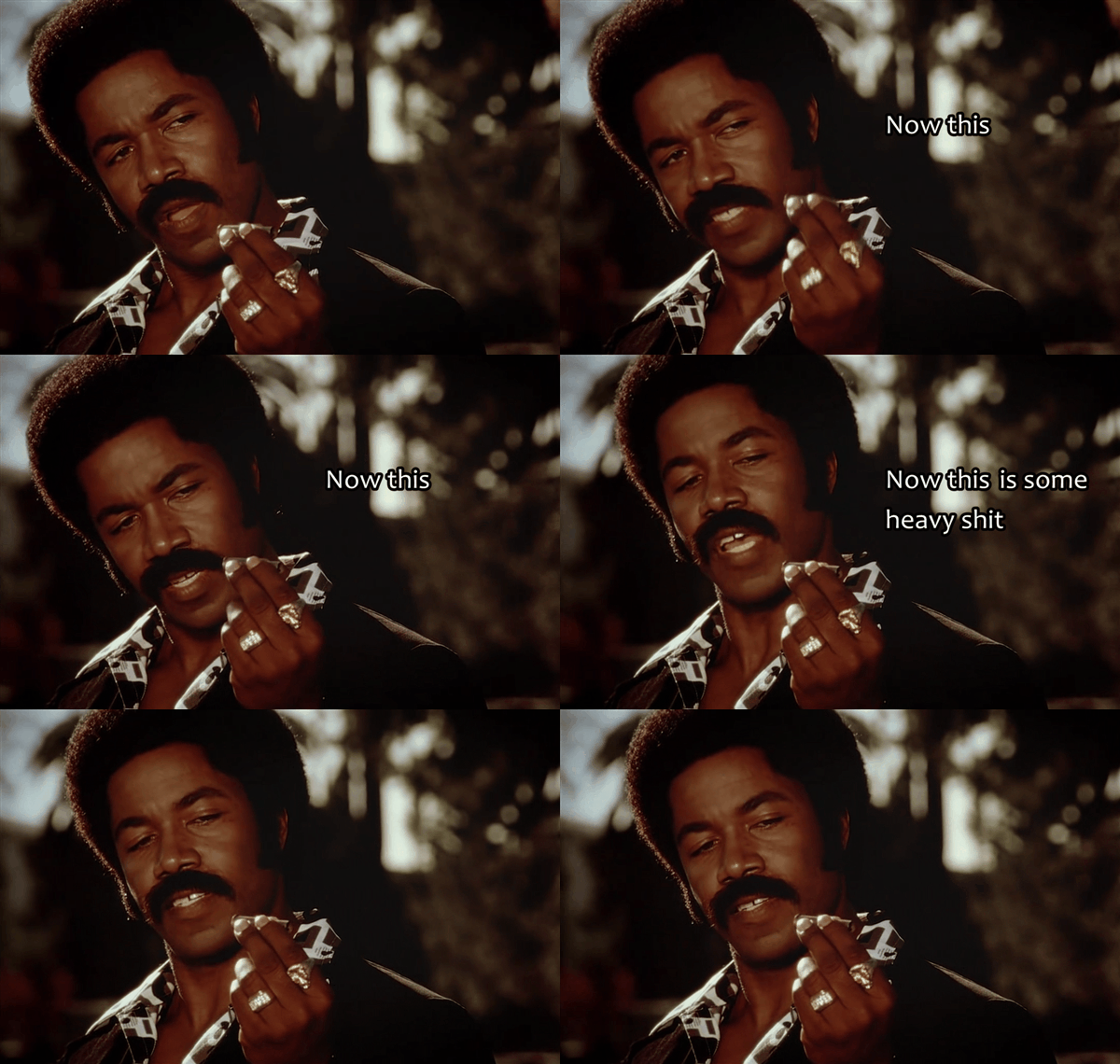
105909-Black-Dynamite-now-this-is-som-gQ4KNone of the class was role play. As the speaker, we needed to respond from the heart. Some topics of discussion were: “Who are you and why are you here?” “What are your limitations and strengths?” “What aspects of your family were most difficult?” “What excuses do you use to avoid self-care?” “Where does your anger come from?” “How do you react to conflict, and why?” “How do issues of power and vulnerability affect your life?” It may seem crazy to be able to honestly speak this kind of personal truth to complete strangers.  Thankfully, I had two amazing women in my triad who made self-disclosure incredibly easy.

gif-8The goal of all this is to begin fashioning a sense of pastoral presence; a way of being fully attentive to a care-seeker in a way that affirms their worth and dignity as a human being and provides a safe environment from which to begin healing. I learned this requires an enormous amount of self-examination and self-knowledge. It demands that I be the servant-leader. I also learned there is a scary amount of power that comes with ministry. I’m thankful that I’ve chosen a school which teaches the responsibility, compassion and humility necessary to use that power in a way that respects and honors each individual person I meet.

I can’t wait for the fall semester.